
Know whether project or program delivery control still exists, or only the appearance of it.
A project or program can remain active long after confidence in its delivery has begun to weaken. IT Delivery, Program, and Project Health Check offers an evidence-based view of whether the initiative remains deliverable as planned or if hidden risks, dependency strain, execution friction, or narrative instability are already undermining delivery. It helps leadership decide whether to continue, correct, or reset the current path before further value and investment are at risk.
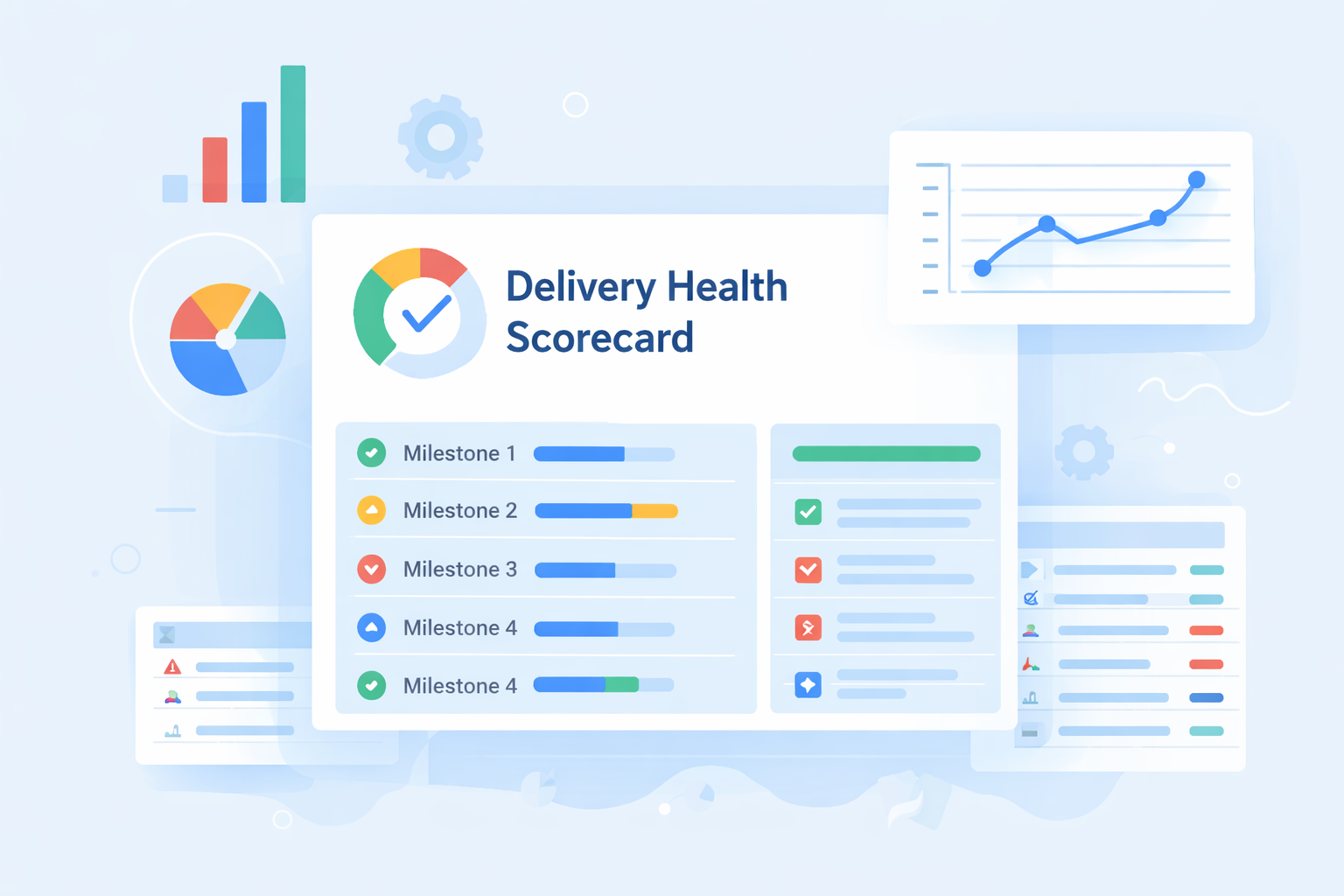
To deliver on our promise, we protect a major business & technology investment by identifying whether IT program and or project delivery risk remains containable before avoidable delays, rework, or escalation compound.
To further support strong outcomes, we provide leadership with an evidence-based assessment of whether the delivery of the IT program and project remains credible, replacing filtered reporting, institutional momentum, or optimism with decision-safe clarity.
Finally, when corrective action is required, our delivery health check process ensures leadership can intervene while there is still room to protect delivery value, sponsor credibility, and, most importantly, the business IT investments.
When IT delivery efforts persist, but control over progress diminishes.
IT Program, and Project, Delivery Health Check is typically commissioned while the initiative still appears active, governed, and progressing, yet confidence in its actual delivery condition is no longer increasing.
Narrative Drift: Status reporting remains broadly positive, but leadership is increasingly uncertain that the reported position still reflects the true delivery condition.
False Confidence: Plans, milestones, steering packs, and status reports continue to indicate control, but the initiative appears less stable or executable than documentation suggests.
Hidden Delivery Friction: Dependencies, sequencing pressure, unresolved actions, or interface issues are quietly reducing delivery certainty beneath the formal reporting layer.
Escalation Without Clarity: Concerns are rising across delivery, PMO, or executive layers; however, there is still no independent view of whether the initiative is genuinely healthy, becoming fragile, or already carrying material risk.

When the delivery narrative and status reports are no longer enough.
We deliver an impartial assessment of whether the current delivery position holds up under evidence, independent of the internal narrative or reporting cycle. This sets the foundation for objective insight.
Based on the findings, we advise leadership to continue the initiative as planned, make selective corrections, or reset it before more value is at risk.
As a result, the review will produce a concise, board-ready delivery position that can be explained and defended under sponsor, steering, or investment scrutiny.
Use IT Delivery Health Check when the initiative still appears active and governed, but the decisions at stake are harder to defend.
This review assesses whether the initiative remains genuinely deliverable as planned — and whether the current delivery position is still credible enough to defend.
Whether the initiative still has a realistic path to deliver under current operating conditions.
Whether external teams, partners, approvals, interfaces, or sequencing pressures remain sufficiently controlled to preserve the forward delivery path.
Whether the initiative is progressing through controlled delivery movement — or being sustained through coordination strain and informal workarounds.
Whether risk is still distributed and manageable, or beginning to cluster around a smaller number of critical weaknesses that could threaten the broader initiative.
Whether key dates, stage gates, and delivery commitments remain believable enough to support continued leadership backing.
Whether current plans, sequencing logic, and resource assumptions still support a credible forward path under real operating conditions.
Whether the right decisions are being made by the right people at the right time to preserve delivery confidence and prevent avoidable slippage.
Evidence is drawn from artifacts that actually determine delivery health — not those that merely report it.
Large-scale clinical, defense, or highly regulated programs often carry additional domain-specific evidence, but the core evidence base typically includes:
Where relevant, this core set is supplemented by sector-specific artifacts such as regulatory assurance evidence, clinical quality gates, or operational readiness criteria.
The level of delivery assurance is calibrated to the scale of the concern, the breadth of delivery exposure, and the degree of decision confidence leadership needs.
| Dimension | Primary Use | Typical Scope | Decision Supported | Confidence Delivered | Value at Stake | Internal Effort | Time to Insight |
|---|---|---|---|---|---|---|---|
| Focused | Used when concern is concentrated in one project, release, or control area | Single initiative, release path, or delivery workstream | Validate, continue, tighten, or intervene | Directional | Prevent near-term drift or hidden delivery deterioration | Minimal | 5–7 days |
| Integrated | Used when multiple delivery streams, dependencies, or stakeholder groups are involved | Cross-functional project or program environment with shared delivery pressure | Re-align, re-scope, stabilize, or recover | High confidence | Restore control across a strained delivery environment | Low–Moderate | 7–10 days |
| Strategic | Used when the initiative is high-consequence and leadership needs an executive-grade position | Enterprise-critical program or transformation initiative | Reset, protect, escalate, or stop | Board-level confidence | Protect major investment, sponsor credibility, and strategic timing | Moderate | 10–14 days |
We do not rely solely on the current narrative.
We test whether the reported position holds up against the evidence that actually determines delivery health, execution credibility, and milestone confidence.
We identify where status reporting, program confidence, or the executive narrative no longer align with the operating evidence.
We surface the delivery conditions — such as dependency pressure, unresolved actions, sequencing weakness, or interface strain — that reduce predictability even when reporting still appears stable.
We test whether milestones, delivery commitments, and forward plans remain credible under actual operating conditions.

A clear decision indicator showing whether the initiative is currently Healthy, Fragile, or Materially At Risk.
A concise view of where the initiative remains credible, where it is weakening, and where structural delivery risk is already accumulating.
A prioritized list of tasks, owners, and actions to restore delivery confidence or enable the next leadership decision.
A project or program is considered back under control when:
The work that most affects the timeline, execution, and certainty of outcome is clearly understood and actively protected.
Executive visibility is reliable enough to support real intervention and confident forward decisions.
Critical actions, unresolved issues, and delivery dependencies have named owners who actively track progress, coordinate resolutions, and report outcomes.
Leadership actions translate into visible movement in sequencing, ownership, delivery behavior, or risk reduction.
Milestones, delivery dates, and forward commitments can be explained and trusted.
Confirm scope, objectives, concerns, and timelines.
Review plans, RAID logs, and governance artifacts.
Short discussions with sponsor, PM/PMO lead, and key technical leads.
Present scorecard, findings, and the 30-day action plan.

A focused, low-footprint review designed to move from uncertainty to a decision-ready position in roughly 10 business days for a single critical initiative. Larger or more complex programs follow the same execution pattern, with greater depth of evidence review and stakeholder validation where required.
Clarify the key delivery question, scope boundaries, current concerns, and leadership decision context.
Examine plans, governance artifacts, delivery records, milestone shifts, and dependencies at the appropriate level for the initiative.
Validate whether the reported position stands under real delivery conditions through targeted stakeholder engagement.
Deliver findings, Delivery Health Signal, and recommended actions, providing clear options for further analysis where scale or risk dictates.
This service is typically commissioned by those who carry delivery, sponsorship, fiduciary, or oversight accountability for a critical initiative.
When a critical initiative remains active, but confidence in delivery certainty is weakening.
When reporting exists, but does not provide enough certainty for intervention or escalation decisions.
When a defensible basis is needed before deciding whether to continue funding, accelerate, or protect a major technology initiative.
When accountability is rising faster than confidence in the current delivery position.
When the initiative is strategically important and leadership needs an independent assessment of whether the current path remains defensible.

Confirmed that a major initiative could still be delivered, but only if leadership tightened sequencing and removed hidden dependency bottlenecks before the next release gate.
Identified that a planned release date remained technically possible but no longer operationally defensible, enabling a controlled delay instead of a high-risk commitment.
Surfaced structural delivery strain that had been masked by stable reporting, enabling intervention four weeks before a missed milestone would have triggered a full recovery cycle and material cost overrun.
This review helps determine what leadership should do next before hidden deterioration becomes visible failure.
Get clarity on whether control still exists — or only the appearance of it.